

Power bank rentals solve a common problem: your phone running out of battery when you’re away from home. By placing rental stations in restaurants, shopping malls, hotels, and other busy places, you can start with just a few stations and grow your network over time.
But how do you start a power bank rental business of your own?
We’ve put together this guide based on our experience at HeyCharge. Whether you want to run your own rental network or supply equipment and software to local operators, you’ll find practical advice to help you get started.
We’ll cover seven steps, from researching your market and choosing a business model to testing equipment, launching your first stations, and growing your business.
Table of Contents
- Step 1: Research Your Local Market
- Step 2: Choose Your Business Model and Branding Approach
- Step 3: Choose Your Equipment and Software Supplier
- Step 4: Order Samples and Test the System
- Step 5: Secure Locations and Prepare for Launch
- Step 6: Run a Pilot and Evaluate Performance
- Step 7: Build Your Operations and Scale the Network
- Conclusion
Step 1: Research Your Local Market
Before buying equipment, take some time to understand your local market. Where are your potential customers? Which areas already have rental stations? What do local customers expect from a charging service?
Industry reports can give you a broad view of the power bank rental market. But demand can vary between cities, neighborhoods, and even individual businesses. To find opportunities in your area, you’ll need to take a closer look.
Fortunately, getting started is quite simple. Here are four practical ways to research your local market.
Method 1: Explore Station Maps
If you know any power bank rental brands in your area, download and open their apps. Most apps have a station map that helps customers find nearby rental stations. You can also use these maps to see where each brand has placed its stations.
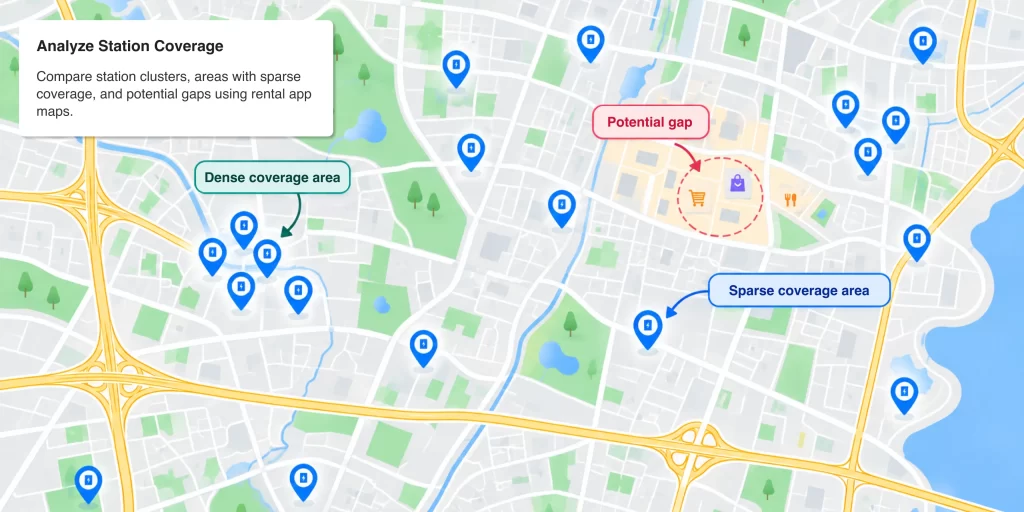
Look for two things:
- Existing coverage: Where does each brand have the most stations?
- Potential gaps: Which business areas or types of venues seem to have relatively few stations?
Comparing these maps can give you a first look at local station coverage. For example, you might find a busy shopping area with relatively few stations. Add it to your list of places to visit, along with areas where stations are already common.
If you haven’t found any local rental brands, you can use Google Maps instead. Look for busy commercial areas with restaurants, bars, shopping malls, hotels, and entertainment venues. These can be good starting points for your field research.
Method 2: Visit Commercial Areas
Use the maps to choose a few commercial areas to explore in person. If possible, visit both areas with existing rental stations and areas with fewer stations.
Your goal is to find locations that could attract rentals, identify suitable equipment, and discover businesses you might work with.
Visit different types of venues, including restaurants, bars, shopping malls, hotels, and entertainment venues.
As you walk around, pay attention to:
- Existing stations: Which brands and station types are installed? How common are they in the area?
- Customer activity: Which venues attract a steady flow of customers? How long do people stay, and how often do they use their phones?
- Station placement: Where are existing machines placed? Are they easy to see and use? What types of stations would fit the available space?
- Potential partners: Which businesses have suitable locations but don’t currently offer power bank rentals?
Keep a simple spreadsheet of the businesses you visit. Record their names, addresses, venue types, and existing charging facilities. You can also record anything useful you notice about customer activity or possible places to install a station.
After visiting several areas, review your notes. Which areas look most promising? What station types would work best? Which businesses would you approach first?
This will help you decide where to focus when you’re ready to install your first stations.
If you’re planning to become a distributor, these visits can also show you which products and brands are already being used in your local market.
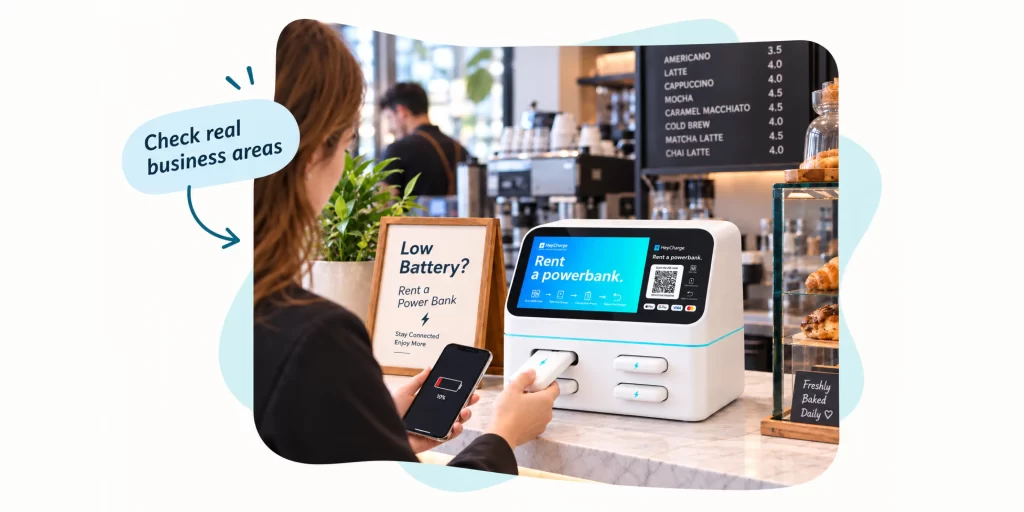
Method 3: Try Renting a Power Bank
Go through the full customer journey: scan the QR code, make a payment, borrow a power bank, use it, and return it.
Pay attention to how easy the process is. Check which payment methods are available, how clearly prices are shown, and how convenient it is to return the power bank. Also look at the equipment itself, including charging speed and connector compatibility.
Trying these services yourself can teach you a lot. You’ll see what local customers are already familiar with, which features work well, and what could be improved.
For example, if a service requires too many steps before customers can borrow a power bank, you may want a simpler process for your own business. If certain payment methods are widely used, make sure your software can support them.
Compare your experiences and write down the important features of each service. These notes will help you choose the right equipment and software later.
Method 4: Talk to Local Businesses
Now it’s time to put your people skills to work.
Maps and trial rentals can tell you a lot, but some things are best learned by talking to people.
For example, equipment problems, customer complaints, and other daily issues may only become clear after a station has been operating for some time.
Employees and managers at businesses with rental stations may have firsthand experience with these issues. Those at businesses without stations can also tell you about local charging needs.
Situation A: The Business Already Has a Rental Station
Employees see how customers use the station every day. They may be able to tell you how well the service works in practice.
You could ask:
- “Do many customers use the station?”
- “What problems do customers usually run into?”
- “If the machine breaks down, how long does it take to get fixed?”
- “How has the service been working out for you?”
If you have a good conversation with the owner or manager and they seem comfortable sharing more, you can gently ask about their partnership:
- “How long has the station been here? Which company operates it?”
- “Does the business receive a fixed payment or a share of rental revenue?”
- “Who handles installation, maintenance, and customer issues?”
- “How long does the agreement last? Does it allow you to work with other charging providers?”
- “What do you like about the current arrangement, and what would you change?”
These conversations can help you understand how local operators work with businesses, what problems matter most to venue owners, and whether some merchants might be interested in working with another provider.
Situation B: The Business Doesn’t Have a Charging Station
Businesses without rental stations are worth talking to as well.
Ask whether customers often need to charge their phones and how staff currently handle these requests.
If you get a chance to speak with the owner or manager, ask whether they’d be interested in offering a rental service and what they would expect from a provider.
If the conversation goes well, exchange contact details. You might find one of your first business partners before you’ve even bought any equipment.
What Should You Have After Your Market Research?
By this point, you should have a better understanding of local competitors, rental prices, popular payment methods, promising venue types, and potential business partners.
You should also have a starting list of businesses to contact.
If you want to become a distributor, look into both existing rental operators and businesses planning to enter the market. Find out what equipment and software they need and whether you could supply them.
What you’ve learned will help you decide how to enter the market and which business model makes the most sense for you.
Step 2: Choose Your Business Model and Branding Approach
After researching your market, it’s time to decide what kind of business you want to run and which brand you want to use.
In the power bank rental industry, there are two main business roles:
- Operators work with restaurants, hotels, shopping malls, and other venues to deploy and manage rental stations. They earn revenue from power bank rentals and may share a portion with venue partners.
- Distributors sell rental equipment and related services to local operators, resellers, and other business customers. Their income primarily comes from equipment sales and related services.
You can also do both: run your own rental network while selling equipment to other businesses.
Once you’ve chosen your direction, the next decision is whether to work with an existing brand or create your own.
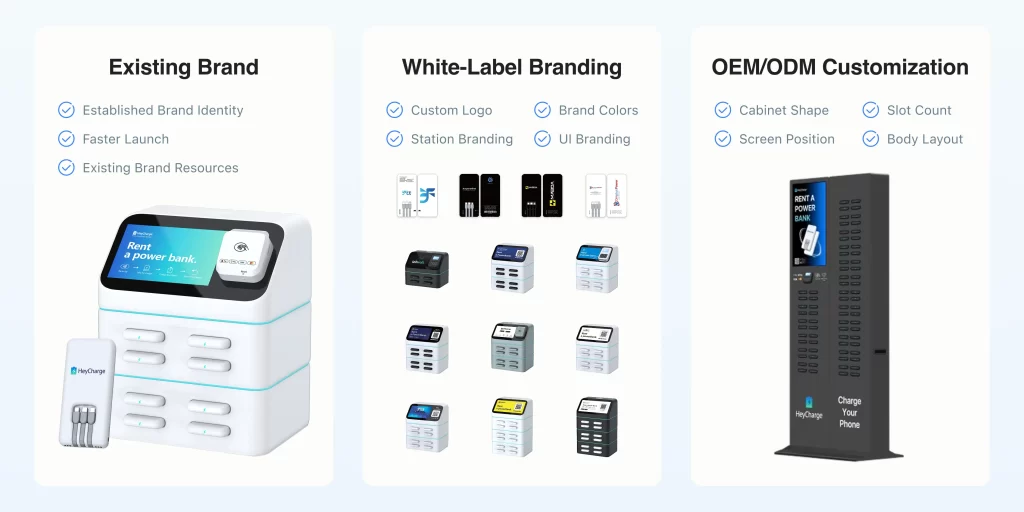
1. Partner With an Established Brand
If you want to enter the market quickly without spending much time building a brand, working with an established power bank rental company can be a practical option.
Depending on its partnership program, you may become a regional agent, distributor, or operating partner. You can use the company’s existing brand, equipment, and software while focusing on local business development and operations.
If the brand is already recognized in your market, it may also be easier to introduce the service to merchants.
Before signing an agreement, make sure you understand the brand usage rights, territory, equipment purchasing terms, software fees, revenue sharing, and each party’s responsibilities.
Also check whether there are any exclusive rights or restrictions, how the contract can be renewed, and what happens when the partnership ends.
2. Build Your Own Brand With a White-Label Solution
If you want to run a business under your own brand, a white-label solution is another option.
With white labeling, you use a supplier’s existing rental stations and software but display your own brand on the equipment and customer rental pages.
This lets you build your brand without having to develop the hardware and software from scratch. It’s a common choice for operators building their own rental networks and distributors who want to sell products under their own brands.
The supplier typically continues to maintain the underlying software and provide technical services. White-label arrangements generally don’t include ownership of the software source code, so make sure the agreement covers ongoing software fees, server services, support, and any additional development requirements.
3. Do You Need OEM/ODM Customization?
Most new businesses can start with existing station models and standard branding options.
If you have specific hardware requirements, some suppliers also offer deeper OEM (Original Equipment Manufacturer) / ODM (Original Design Manufacturer) customization, such as changes to the station’s dimensions, materials, appearance, or slot configuration.
More advanced customization can involve extra design work, prototypes, testing, tooling fees, and higher minimum order quantities. For most beginners, starting with standard equipment is more practical. You can consider further customization as your business grows.
Building an entire hardware and software system yourself is also possible if your company has its own engineering and manufacturing resources. However, this takes much more money and time, and you’ll be responsible for maintaining the system afterward.
Whichever approach you choose, make sure your agreement clearly explains your rights to set rental prices, operate in your chosen area, manage merchant relationships, and handle daily operations.
Step 3: Choose Your Equipment and Software Supplier
A reliable supplier plays an important role in the success of your power bank rental business. You’ll need durable equipment, software that works well with the hardware, and ongoing technical support to keep your network running smoothly.
Contact a few experienced suppliers. Ask for product specifications, prices, and software demos. Compare their complete solutions, not just the equipment prices.
1. Supplier Experience and Reliability
Look for suppliers with several years of experience in the power bank rental industry. Ideally, they should have a good record of supporting operators and brands in different countries.
Ask whether they’ve worked in your target country or a similar market.
Experience in these markets can help them understand local payment methods, mobile networks, product certification requirements, and common operating problems.
It’s also worth checking whether the supplier has its own product development team, manufacturing facilities, and reliable supply chain. These can make a difference in product quality, delivery times, and the ability to supply more equipment as your business grows.
Ask for examples of past projects, product certifications, and details of how the supplier checks product quality. Also confirm how much they can produce, how long orders usually take, and whether spare parts are available.
A supplier that can support both your first launch and future growth may be a better choice than one offering the lowest price.
2. Choosing the Right Hardware
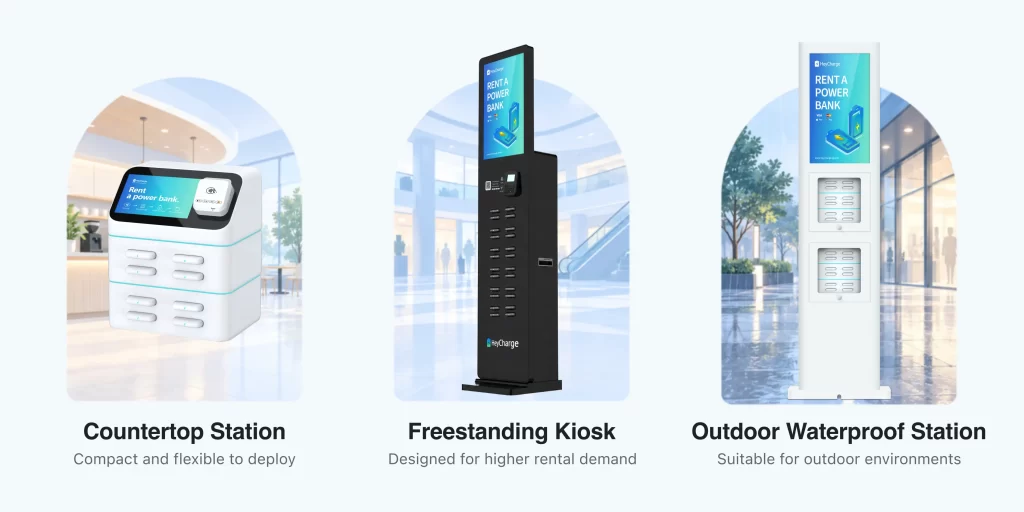
Different locations need different types and sizes of rental stations:
- Compact countertop stations: Suitable for restaurants, cafés, bars, and small retail stores where counter space is available.
- Freestanding kiosks: Better suited to shopping malls, transportation hubs, hospitals, and other high-traffic locations that may need greater rental and return capacity.
- Outdoor rental stations: Designed for outdoor locations such as tourist attractions, shopping streets, and public squares, where weather resistance and operating temperature matter.
Station size is only one part of the decision. You should also check the quality and durability of the equipment. Look at the power bank release mechanism, locks, charging contacts, and overall build quality. Reliable parts can help prevent equipment problems and reduce maintenance costs.
For the power banks, compare battery capacity, charging speed, connector compatibility, battery cycle life, and safety features.
Also make sure the products meet the certification and shipping requirements of your target market.
3. Software Platform and Rental Experience
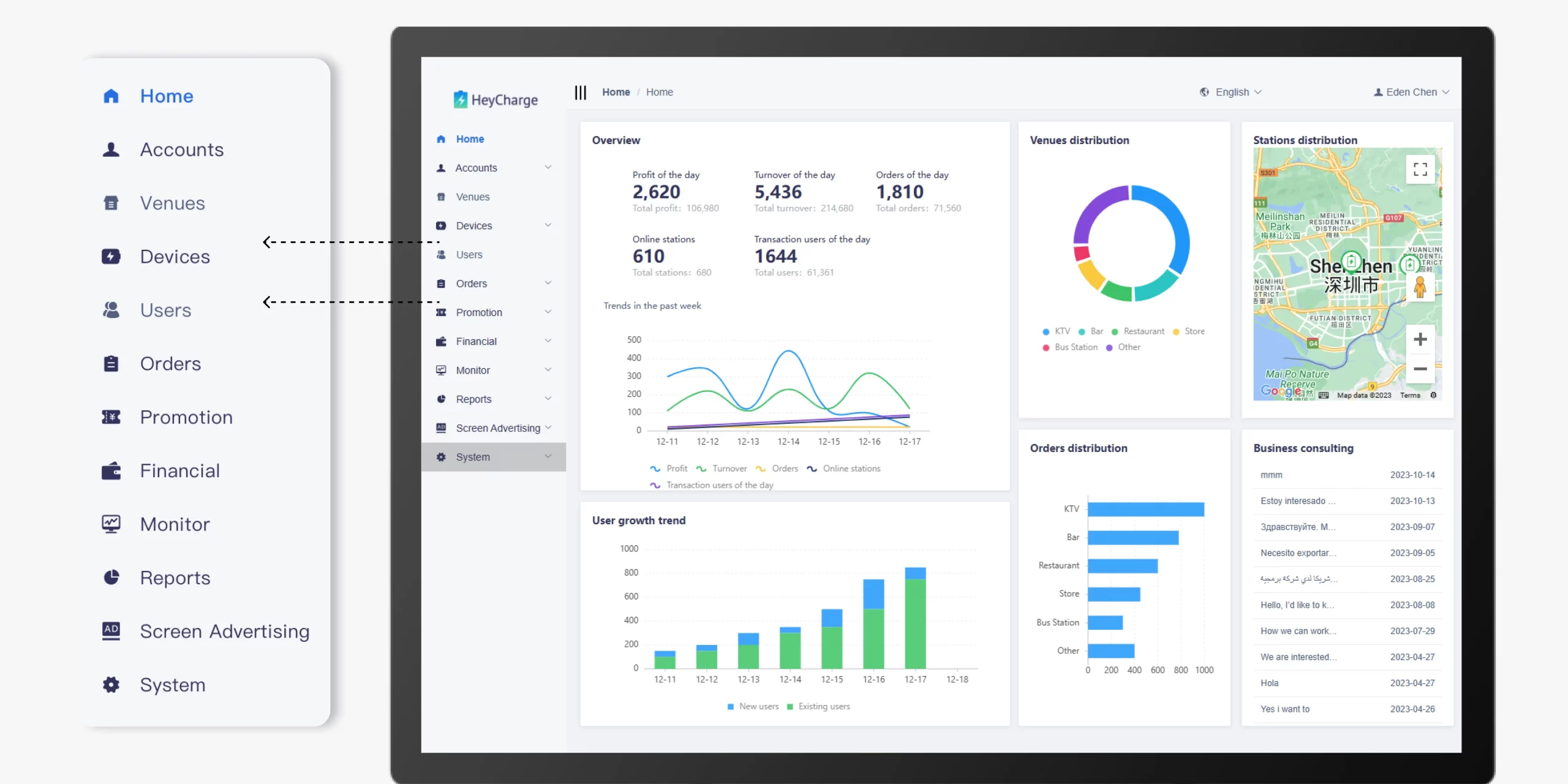
The software matters just as much as the hardware. Ask suppliers to show you both the customer rental process and the management platform.
Pay attention to these features:
- Rentals and payments: QR-code rentals, local payment methods, configurable pricing, free periods, deposits or pre-authorizations, refunds, and overdue charges.
- Remote station management: Monitor connectivity, available power banks, and return slots. Check whether remote dispensing, troubleshooting, and firmware updates are supported.
- Merchant and distributor management: Create accounts, assign permissions, manage partner relationships, and configure revenue sharing.
- Reporting and analytics: Track rental orders, revenue, payment status, and station performance across different locations.
- Localization: Support for the languages, currencies, and payment methods used in your target market.
These features become more important as your network grows and you work with more merchants and business partners.
4. Branding, Customization, and After-Sales Support
If you’re building your own brand, ask suppliers to show examples of their previous customization projects. Find out which branding options are available for the stations, power banks, and rental pages. Also check which changes need extra design work or have minimum order quantities.
For example, HeyCharge provides power bank rental equipment, software, and a management platform, along with white-label branding options. Our hardware is designed for frequent daily use and long maintenance intervals, helping partners reduce equipment downtime, maintenance work, and long-term operating costs.
After-sales support is equally important. Confirm warranty coverage, spare parts availability, software maintenance, and procedures for handling equipment faults. If you’re operating internationally, reliable remote technical support can save considerable time and effort.
5. Compare Costs and Review the Contract
When comparing quotations, consider both upfront and ongoing expenses:
- Upfront costs: Stations, power banks, spare parts, branding, shipping, import duties, and initial software setup.
- Ongoing costs: Software and server fees, mobile data, payment processing, maintenance, and replacement parts.
Software fees can be charged in different ways. Some suppliers charge per station, some charge based on transactions or rental revenue, and others offer a fixed subscription. Make sure you understand how the fees are calculated and what services are included.
Before signing a contract, check the product specifications, delivery terms, payment schedule, warranty, technical support, software services, and data-related terms. If you expect to order equipment regularly, it’s also worth discussing future prices and spare parts supply.
Once you’ve narrowed down your suppliers, the next step is to order samples and test the system before making a larger investment.
Step 4: Order Samples and Test the System
Before placing a large order, buy samples of the equipment you plan to deploy. This gives you a chance to check the product quality, try the rental process, and find problems before spending more money.
If you plan to offer several station types, consider testing both a compact countertop model and a freestanding kiosk.
1. Inspect the Hardware
Start by examining the stations and power banks. Check the materials, finish, assembly quality, and components such as slots, locks, screens, and card readers.
Try borrowing and returning power banks several times. Make sure they come out smoothly, are recognized correctly when returned, and charge as expected.
Leave the station running for a longer period. Watch for unusual temperatures, connection problems, or other signs of poor performance.
2. Test the Complete Rental Process
Try the entire rental process on different smartphones: scan the QR code, authorize a payment, borrow a power bank, charge a phone, and return the power bank.
Test every payment method you plan to offer. Make sure rental fees are calculated correctly under different pricing rules, including free rental periods, billing intervals, and daily price caps.
If you plan to support returns across multiple locations within your rental network, use two stations to verify that the return is recognized and billing stops correctly.
It’s also worth asking a few people who have never used a power bank rental service to try it. See whether they can complete a rental without assistance and where they encounter difficulties.
3. Test Error Scenarios and Management Features
Once normal rentals are working properly, check how the system handles common problems:
- Failed dispensing: What happens if payment succeeds but no power bank is released?
- Return issues: What if a power bank is returned but the order doesn’t close?
- Network interruptions: How does the station behave when its connection is lost?
- Payment issues: How are refunds, overdue charges, and other payment problems handled?
Some problems may be difficult to reproduce yourself. Ask the supplier to demonstrate or simulate them.
Also test the management platform, including order records, station monitoring, remote operations, reporting, and merchant or distributor accounts where applicable.
If you run into a problem, contact the supplier’s technical support team. This is a good opportunity to see how quickly they respond and how well they solve issues.
Keep a record of the problems you find. Make sure they’re fixed and tested again before you place a larger order.
See HeyCharge in Action
Explore our rental stations, rental experience, and management platform through a live online demo or an in-person visit. You can also arrange a factory tour.

Step 5: Secure Locations and Prepare for Launch
For operators, finding suitable locations is one of the most important parts of building a power bank rental business.
Your market research should have given you a starting list of businesses you could work with. Now it’s time to contact them, discuss partnership terms, and prepare to install your first stations.
1. Choose Your First Locations
Start with venues that have steady foot traffic, where customers spend some time and often use their phones. Make sure there’s a visible, convenient place for the station and that the location is easy to maintain.
Restaurants, bars, cafés, and entertainment venues are good places to explore.
Also consider the distance between stations. Building a cluster within the same commercial district makes maintenance and power bank redistribution easier while giving customers more nearby places to rent and return.
For your first deployments, try a few different venue types to compare their performance, but keep the stations close enough to manage efficiently.
2. Approach Merchants and Present Your Offer
For small and medium-sized businesses, visiting in person is often an effective way to reach the owner or manager.
Keep your introduction simple. Explain how the rental service works, how it benefits their customers, and what the business could earn through a partnership.
Bringing a sample station or demonstrating the rental process can help merchants understand the service and make the conversation more productive.
For larger organizations, such as restaurant chains, shopping malls, and hotel groups, you may need to contact their operations, property management, or partnership teams.
These businesses may expect a formal proposal covering equipment, commercial terms, operational responsibilities, and technical support.
3. Negotiate Partnership Terms
A common arrangement is for the operator to provide and maintain the stations at no upfront cost to the venue, then share a percentage of rental revenue with the merchant.
Other arrangements are possible, including fixed payments, equipment purchases, or leasing. The terms will depend on local market practices, the value of the location, and what each party contributes.
Before signing, make sure your agreement clearly covers:
- Equipment and site requirements: Who owns the station and provides power, connectivity, and suitable placement?
- Payments and revenue sharing: How are payments or revenue shares calculated and settled?
- Maintenance and support: Who handles equipment faults, damage, and customer complaints?
- Contract terms: What are the duration, exclusivity requirements, renewal conditions, and removal arrangements?
You can use what you learned about competitors’ partnerships during your market research to prepare a more attractive offer.
Before signing agreements or accepting rental payments, also check the business registration, tax, payment account, and other legal requirements that apply in your market.
4. Prepare for Installation and Launch
Once you’ve secured your first locations, confirm the power supply, network coverage, available space, and any site-specific requirements.
If the station uses cellular connectivity, arrange the SIM card and data service in advance.
Connect each station to your management account, configure the payment methods and rental pricing, and set up merchant revenue sharing where applicable.
After installation, complete a test rental and return at each location. Show venue employees how the service works and who to contact if customers need assistance.
If You’re a Distributor
For distributors, this stage is about finding your first business customers rather than securing rental locations.
Potential customers include existing rental operators, equipment dealers, regional agents, and businesses planning to launch their own networks.
Focus your discussions on equipment options, software, pricing, customization, delivery times, and after-sales support. Offer samples or an online demonstration, then prepare a quotation based on the customer’s needs.
For potential long-term partners, you can also discuss bulk purchasing, regional distribution agreements, branding, and ongoing technical support.
Step 6: Run a Pilot and Evaluate Performance
Once your first stations are installed, you’ll start collecting real operating data. This is your chance to find out which locations perform well, what needs improvement, and whether your business is ready to expand.
Let the pilot run across both weekdays and weekends, and collect enough data to identify meaningful patterns before investing in more equipment.
1. Monitor Rental Performance
Use your management platform to track the performance of each location. Focus on four key areas:
- Rental activity: How many rentals does each station generate per day, and when are the busiest periods?
- Rental revenue: How much income does each station generate?
- Station availability: Are stations frequently offline, out of available power banks, or full with no empty return slots?
- Customer issues: Are there payment failures, return problems, refund requests, or other complaints?
Compare the results across different locations and venue types. For example, a bar and a café in the same district may have very different rental patterns because of their customers, opening hours, and smartphone usage.
These differences can help you understand where demand is strongest and which types of venues are worth prioritizing.
2. Calculate Operating Earnings by Location
A high number of rentals doesn’t always mean higher profits. You also need to consider the costs of running each station.
A simple way to estimate each location’s operating contribution is:
Location operating contribution = Rental revenue − Venue revenue share − Payment processing fees − Software and connectivity costs − Maintenance and replacement costs
If some expenses are shared across multiple stations, allocate a reasonable portion to each location when comparing performance.
For example, a busy location may generate disappointing returns if the venue’s revenue share or operating costs are particularly high. Meanwhile, a station with moderate rental activity and lower costs could produce better results.
This calculation shows operating earnings before recovering your initial equipment investment. To estimate your payback period, compare those earnings with the upfront costs of equipment and deployment.
Recommended reading: Power Bank Sharing ROI: Payback Within 12 Months
3. Improve Locations and Plan Your Next Investment
Use your pilot results to identify which stations are performing well and which need attention.
You can group your locations into three categories:
- Strong performers: Keep them running and look for similar venues when expanding your network.
- Promising locations: Look for ways to improve performance. If power banks or return slots are frequently unavailable, adjust inventory or station capacity. If rentals are low despite good foot traffic, review placement, visibility, and pricing.
- Consistently weak performers: If results remain poor after reasonable adjustments, consider relocating the station to a more promising venue.
For distributors, early customer deployments are also an opportunity to gather feedback on product quality, software, delivery, and after-sales support. This can help you improve your offering and identify opportunities for repeat orders.
By the end of your pilot, you’ll have a clearer picture of which locations, equipment configurations, and operating practices work best in your market. Use those findings to guide your next investment.
Step 7: Build Your Operations and Scale the Network
Once your pilot has shown which locations and operating practices work best, you can start planning your expansion.
As your network grows, managing stations, supporting customers, and working with merchants will become more demanding. Establishing reliable operating procedures early will help you expand while maintaining service quality.
1. Establish Day-to-Day Operating Procedures
The main responsibilities of a power bank rental operator fall into four areas:
- Station management: Monitor station connectivity, power bank availability, and equipment faults. Arrange remote troubleshooting or on-site maintenance, and redistribute power banks between locations when needed.
- Customer support: Provide a clear support channel for rental, payment, and return issues. Keep records of common problems and their solutions so your team can resolve them efficiently.
- Merchant relationships: Keep venue partners informed about station performance, settle revenue shares on schedule, and respond to their feedback.
- Financial management: Reconcile rental orders, payments, transaction fees, merchant payouts, and operating expenses to keep track of your business performance.
You may be able to handle most of these tasks yourself when operating a small network. As you expand, make sure each responsibility is clearly assigned.
2. Standardize Your Processes
Managing a handful of stations is quite different from managing dozens or hundreds. As your network grows, relying on informal communication and manual recordkeeping becomes increasingly difficult.
Create clear steps for contacting merchants, signing contracts, delivering and installing equipment, setting up the system, helping customers, and handling payments.
If you work with employees or regional partners, clearly define their responsibilities, assigned locations, and management system permissions.
Having a consistent process makes it easier to train new team members, deploy additional stations, and maintain service quality across your network.
3. Expand Around Proven Demand
Use the results of your pilot to identify the venue types, station configurations, and pricing strategies that perform best in your market.
For example, if entertainment venues consistently generate strong rental activity, you can prioritize similar businesses when looking for new partners.
Whenever practical, expand into commercial districts near your existing stations. A more concentrated network reduces travel and maintenance time, makes power bank redistribution easier, and gives customers more convenient rental and return locations.
As you grow, continue comparing the performance of new locations with your existing network and adjust your expansion plans based on the results.
4. How Distributors Can Scale Their Business
For distributors, growth depends more on expanding your customer base, strengthening sales channels, and providing reliable support.
Use successful customer projects and feedback to approach additional operators, equipment dealers, and regional partners.
Prepare standard product presentations, software demonstrations, installation instructions, and training materials. These resources can help your customers launch their services more efficiently while reducing the amount of support needed for each new project.
For long-term customers, consider bulk purchasing arrangements, regular equipment replenishment, spare parts supply, and branding services based on their needs.
As your customers expand their rental networks, they may also bring repeat equipment orders and ongoing service opportunities.
Whether you’re an operator or a distributor, sustainable growth depends on building repeatable processes and maintaining reliable service as your business expands.
Conclusion
Starting small gives you room to learn. For operators, your first few locations can help you understand real customer demand and operating costs. For distributors, early customer projects provide valuable experience in equipment supply, software support, and building long-term partnerships.
As your business grows, use what you’ve learned to improve your operations, strengthen customer relationships, and expand with greater confidence.
If you’re planning to start a power bank rental business, HeyCharge can help you explore equipment options, rental software, and branding solutions. Feel free to contact us to discuss your project or arrange a live demonstration before making a purchase.