

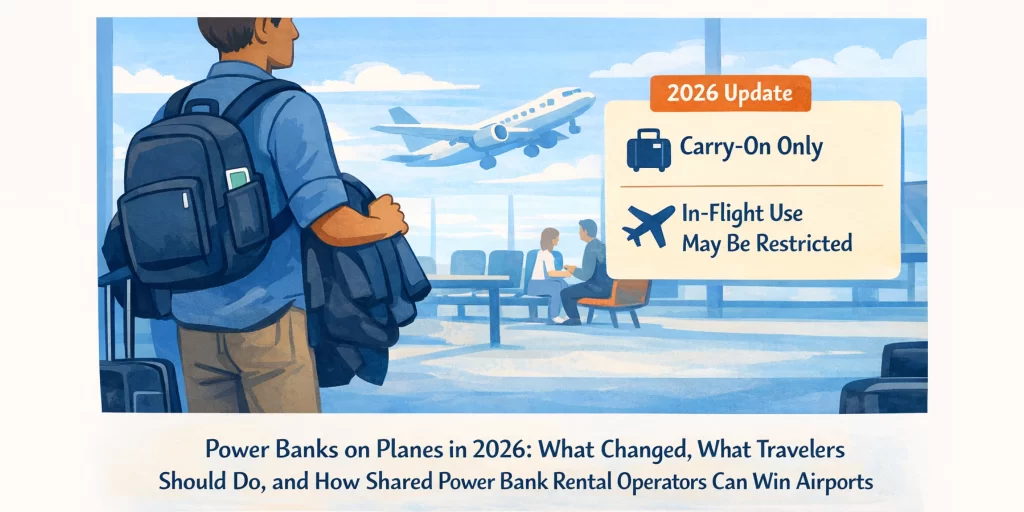
Let me guess: you’ve got a power bank in your bag right now.
That’s normal. What’s not normal is how quickly airline rules have tightened lately.
Just this week, India’s aviation regulator (DGCA) was reported to ban using power banks to charge devices during flight and also ban charging power banks via in-seat power, with guidance that they should stay in hand luggage and not in overhead bins. (Reported Jan 2026.) (The Economic Times)
And it’s not just India. In Australia, Qantas/Jetstar introduced new safety measures effective 15 Dec 2025: no using power banks onboard, no charging them onboard, and a push to keep them within reach. (QANTAS)
Singapore Airlines did something similar earlier: from 1 Apr 2025, no charging devices with power banks inflight, and no charging power banks via onboard USB. (Agent 360)
China also tightened enforcement: from 28 Jun 2025, the CAAC says passengers on domestic flights can’t carry power banks without clear CCC/3C markings, with unclear marks, or recalled models/batches. (CAAC)
So yeah—if you feel like policies suddenly got strict, you’re not imagining it.
Let’s talk about what changed, what you should do as a traveler, and why this is quietly becoming a big opportunity for shared power bank rental operators in airports.
Table of Contents
- Part 1. What changed going into 2026?
- Part 2. The rules that still don’t surprise anyone (your safe default)
- Part 3. What you should do as a traveler (without turning it into homework)
- Part 4. Why this is a tailwind for shared power bank rental operators
- Part 5. Safety you can carry with confidence (on planes—and everywhere else)
- Closing thought
Part 1. What changed going into 2026?
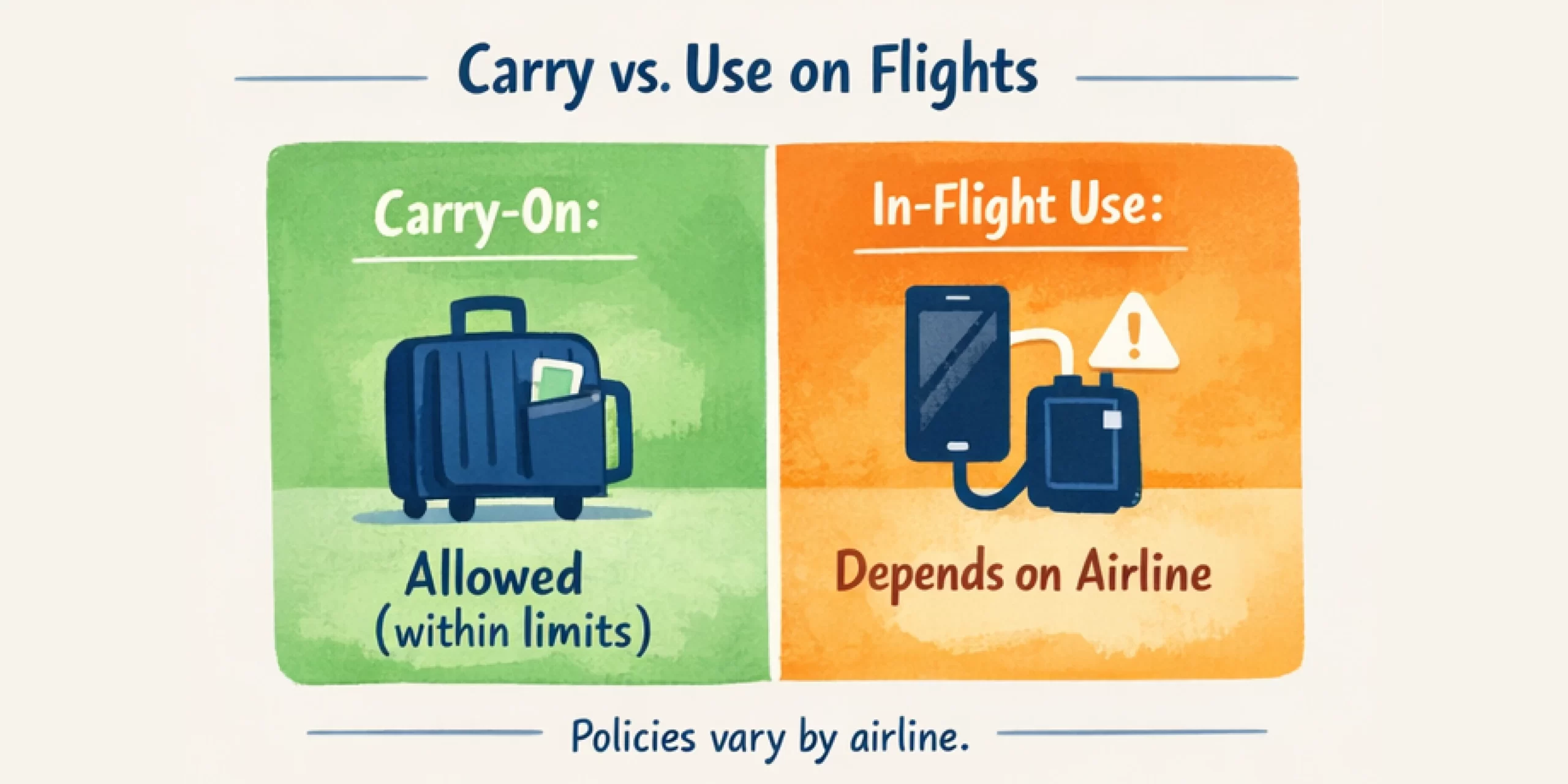
1.1 Airlines are separating “carry” from “use”
For a long time, most people assumed: If I can bring a power bank, I can use it.
That assumption is now risky.
- Singapore Airlines: carry is allowed within rules, but usage and charging are not allowed throughout the flight.
- Qantas/Jetstar: use prohibited, and charging prohibited (including via in-seat power or USB).
- India (reported): tightening goes the same direction—no in-flight charging use, and no charging via seat power.
1.2 “Keep it reachable” is becoming the default expectation
Why do airlines care where you put it? Because if something gets hot or smokes, seconds matter.
Qantas’ guidance explicitly says power banks/spares/PEDs should be with the passenger, ideally in the seat pocket or under the seat, otherwise in a nearby overhead locker.
Australia’s ABC also summarized that airlines are pushing “within reach” rules and noted differences between carriers.
1.3 Some markets are now checking compliance “on sight”
China’s CAAC notice is a great example of the direction travel is heading: if markings are unclear—or a model is recalled—you can lose the right to bring it onboard (for China domestic flights).
That changes traveler behavior fast: people become less willing to gamble on unknown or poorly labeled devices right before a flight.
Part 2. The rules that still don’t surprise anyone (your safe default)
Even as airlines add new restrictions, these “base rules” stay remarkably consistent:
- Carry-on only: power banks are generally treated like spare lithium batteries, which typically means carry-on, not checked baggage.
- Know your limits: many airlines use the familiar “up to 100Wh” baseline, with tighter rules or approvals above that; some carriers now also cap quantity (e.g., Qantas: up to two, each up to 160Wh).
- Prevent short circuits / damage: keep the device protected and avoid bringing anything swollen, cracked, or overheating.
If you want the simplest mental model: carry it on, keep it protected, keep it reachable, and don’t assume you can use it in the air.
Part 3. What you should do as a traveler
1. Before you fly, look up your airline’s policy
It takes 60 seconds, and it’s the difference between “smooth trip” and “awkward conversation at the gate.” (Policies vary a lot.)
2. Treat inflight use as “maybe not”
If you’re flying airlines with explicit bans (Singapore Airlines, Qantas group), don’t try your luck.
3. Keep it easy to show, easy to reach
Not buried, not crushed, not in a mystery pocket you forget exists.
4. If you’re flying China domestic, pay attention to markings
The CAAC restriction on CCC/3C marks and recalled models is explicit, and enforcement can be strict.
Part 4. Why this is a tailwind for shared power bank rental operators
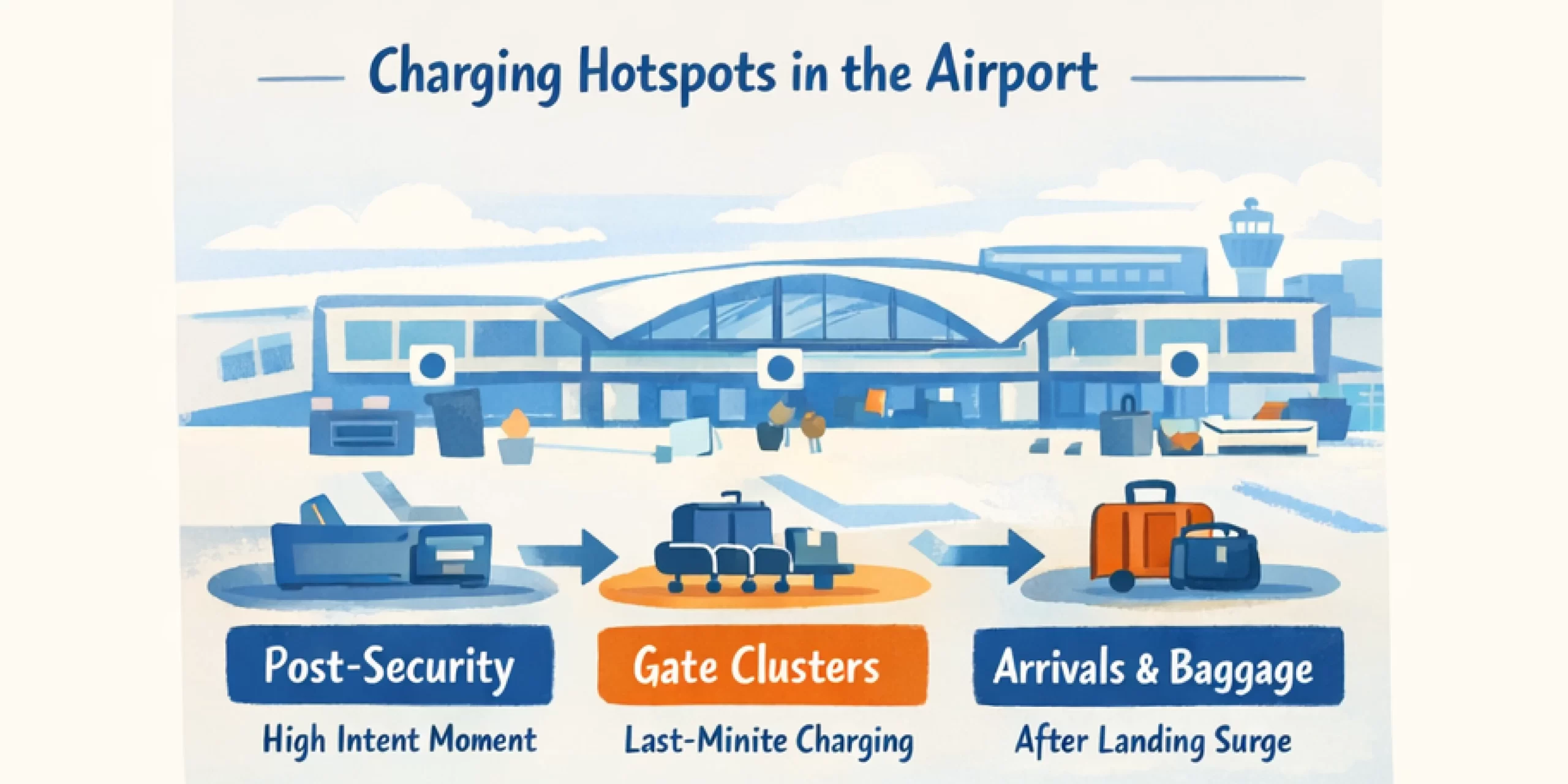
Here’s the interesting part: tighter inflight rules don’t reduce charging demand—they move it.
When passengers can’t count on inflight charging, they do two things:
- charge hard before boarding
- panic-charge after landing
That concentrates demand in exactly the places shared power bank rentals can win:
- post-security corridors
- gate clusters
- arrival halls and baggage claim exits
- transfer routes between terminals/train links
And the compliance trend adds another boost: as travelers hear about certification enforcement and safety incidents, trust becomes part of the product. A professional rental solution can feel safer than buying a random, poorly labeled power bank at the last minute.
What airport operators should implement now?
- Placement > traffic: put units where urgency peaks (right after security, near gate clusters, near arrivals exits).
- Wave-based replenishment: restock to flight waves, not “once per day.”
- Two-second messaging: “Rent fast before boarding,” “Return anywhere,” “Clear specs / safety-first design.”
- Don’t overpromise: never claim “approved by all airlines.” Policies vary; your credibility is the asset.
Part 5. Safety you can carry with confidence (on planes—and everywhere else)
People don’t just want a power bank that “works.” They want one they feel comfortable carrying daily—train, office, mall, and yes, airports.
The most trustworthy way to communicate that confidence is specific and practical:
- multi-layer protection design (short-circuit, overcharge, temperature, etc.)
- clear labeling and traceability
- compliance readiness for common market and transport requirements
And one important line to keep your message honest:
Even the best-designed lithium battery product still requires responsible handling and following airline rules—especially as inflight-use bans expand.
Closing thought
The 2026 story isn’t “power banks are banned.” It’s this:
Carry is usually fine. Use is increasingly restricted. And enforcement is getting sharper in some places.
For travelers, a quick airline-policy check and sensible handling avoids almost all friction.
For shared power bank rental operators, airports are becoming a clearer, higher-intent battlefield—where speed + trust + placement win.