

Table of Contents
- Part 1. What’s happening: “Location” no longer equals “venue”
- Part 2. Why it’s happening: five underlying drivers
- Part 3. Key lessons for merchants and operators
- Closing: The next winners won’t be those with the most cabinets — but those who place cabinets on traffic and keep availability near-perfect
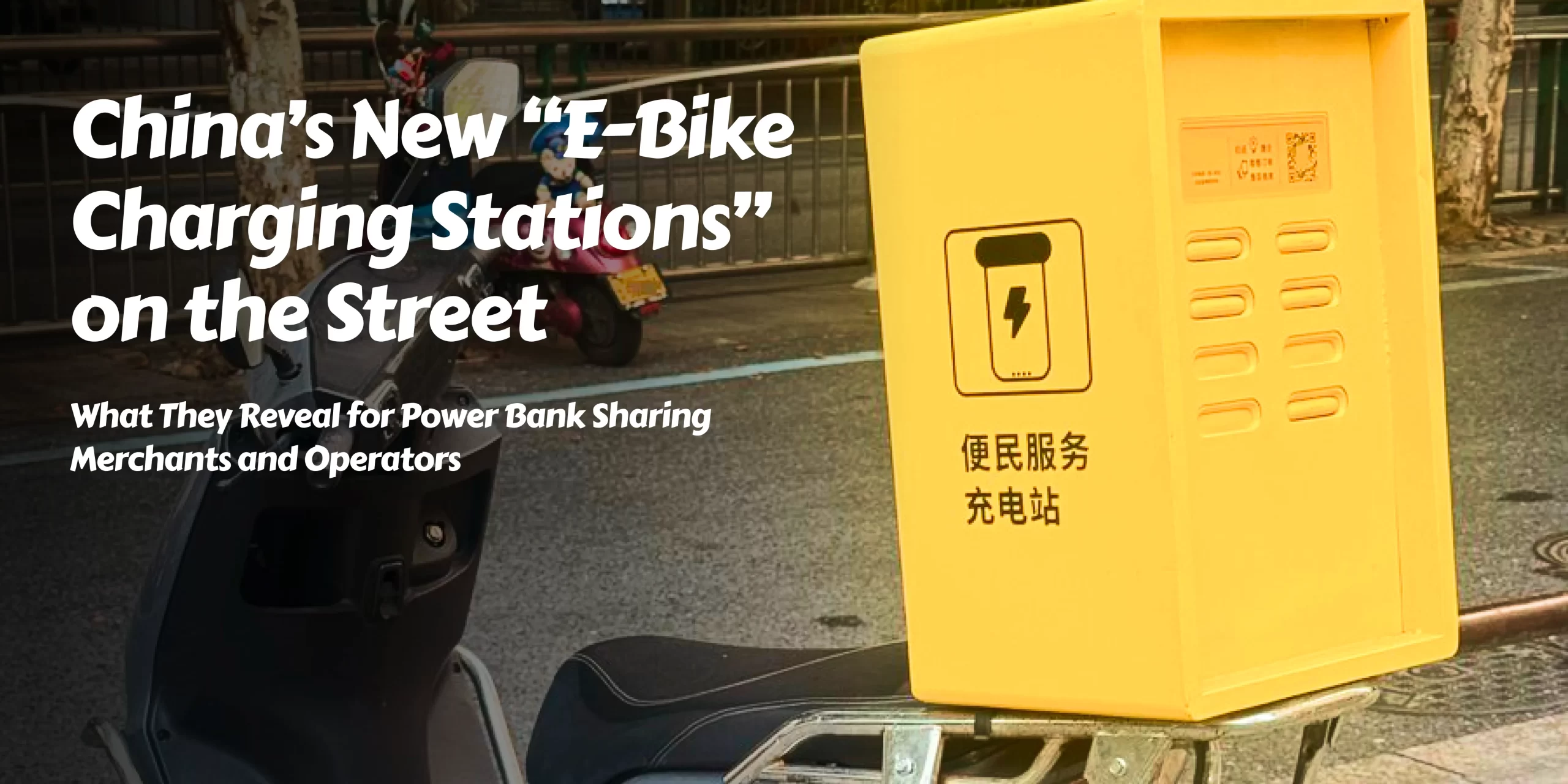
Recently, a new kind of shared power bank “station” has started showing up on the streets in China.
At first glance, it looks like just another parked two-wheeler blended into a row of e-bikes along the curb. But on the rear rack—shaped like a food-delivery trunk—there’s a full shared power bank cabinet built in. If you walk closer, you’ll often see a small sign hanging beside it that reads something like: “Device operating normally. Available for rental.” Almost as if the operator knows how improvised this setup appears, and wants to reassure passersby who might hesitate because of its unusual location and no-frills look.
The first time you see one, you pause: Wait—shared power banks can be deployed like this?
If you treat it as a quirky street novelty, you’ll miss the real signal. This didn’t happen because someone suddenly fell in love with vehicle modifications. It happened because several key variables in the power bank sharing business have shifted at the same time: revenue sharing, location access, growth dynamics, and operating cost structure. When those variables move together, the first group forced to adapt is rarely the platform—or the merchants. It’s the operators and local partners who live closest to cash flow reality.
In this article, we’ll use this street-level phenomenon to uncover the business logic behind it—and to offer more flexible, “break-the-default” lessons for both merchants and operators in power bank sharing.
Part 1. What’s happening: “Location” no longer equals “venue”
Traditionally, power bank sharing scales through indoor venues: restaurants, bars, cafés, malls, cinemas — place cabinets, drive usage, and split revenue.
The new street model does one simple thing: it redefines “location” as a traffic coordinate instead of a storefront address.
Operators deploy cabinets on two-wheelers and park near high-flow scenarios — subway exits, festivals, night markets, camping areas — capturing demand where it actually happens.
A further evolution is “bike + power” integration: fleets and dispatch networks (shared micromobility, delivery operations, local logistics) treat power banks as an add-on service. The vehicle becomes a mobile service terminal, and power banks become a high-frequency entry point.
Bottom line: location assets are becoming multi-form. Venues are no longer the only answer.
Part 2. Why it’s happening: five underlying drivers
2.1 Rising venue revenue share squeezes operator margins
When venue revenue share increases while platform fees remain relatively stable, margin pressure lands directly on operators. ROI stretches, negotiations get harder, and operators search for formats that reduce dependency on venues.
2.2 Prime indoor spots are scarce as markets mature
As growth slows and competition intensifies, cities shift from expansion to a fight over existing demand. Premium indoor locations become harder and costlier to secure — pushing operators toward new scenarios and carriers.
2.3 Mobility rewrites unit economics through flexibility
Mobile deployment isn’t “cool” — it’s arithmetic:
- fewer venue negotiations and less revenue share pressure
- the ability to reposition based on demand spikes
- lower-cost pilots before scaling
2.4 Better power + better backend makes mobile scalable
Historically, mobile had stability and maintenance challenges. Improvements in power solutions, device reliability, and operational tooling turn mobile from “possible” to “repeatable.”
2.5 “Demand stacking”: turning two-wheelers into service entry points
Fleets already have reach, dispatch systems, and daily maintenance routines. Adding a high-frequency charging need to an existing mobility pattern makes service delivery more “on the path” of demand.
Part 3. Key lessons for merchants and operators
Break the default mindset — first-mover advantage comes from getting closer to demand, faster.
Lesson 1: Stop assuming “location = venue”
Don’t wait inside venues for demand. Move toward where demand is happening.
Lesson 2: “Wild” doesn’t mean sloppy — it means fast
The real edge of mobility isn’t only avoiding revenue share — it’s speed:
- festival today, transit hub tomorrow, outdoor hotspot next week
- demand shifts, deployment shifts
- city rhythms change, strategy changes
In mature markets, many opportunities are short-window.
While others are still negotiating a one-month venue contract, you can already be in front of the crowd. That’s where first-mover advantage is created.
Lesson 3: Build a portfolio of models — don’t bet on one
A resilient strategy treats models as tools:
- fixed venues for stable, enclosed, or exclusive scenarios
- mobile units for fluctuating demand and peak capture
- fleet-based deployment where you have strong dispatch + ops
Don’t worship venues, and don’t romanticize mobile. Use the right tool for the right traffic type.
Lesson 4: For merchants, revenue share is a number — availability is the business
Higher revenue share can look like a win, but if it reduces operator investment and worsens maintenance (empty slots, outages, inconsistent experience), absolute earnings decline. Sustainable partnerships focus on peak availability, response time, and experience consistency.
Share % is negotiation. Availability is long-term income.
Closing: The next winners won’t be those with the most cabinets — but those who place cabinets on traffic and keep availability near-perfect
China’s “e-bike charging stations” may look like a street-level novelty, but they point to a simple truth: when fixed locations get expensive and margins thin, the winners are the ones who stay closest to real demand.
In other words:
where demand is, operations must be; where efficiency is, profit follows.
That said, the idea is worth learning from—not blindly replicating. Local rules vary widely, and practices like vehicle modifications, safety shortcuts, or curbside operations can create real risks and may be restricted or illegal in some markets. The real first-mover advantage comes from moving fast and doing it right: break old assumptions, but stay inside the safety and legal boundaries.
If you’d like to explore more partnership opportunities, feel free to reach out—we’d be happy to discuss what could work in your market.