

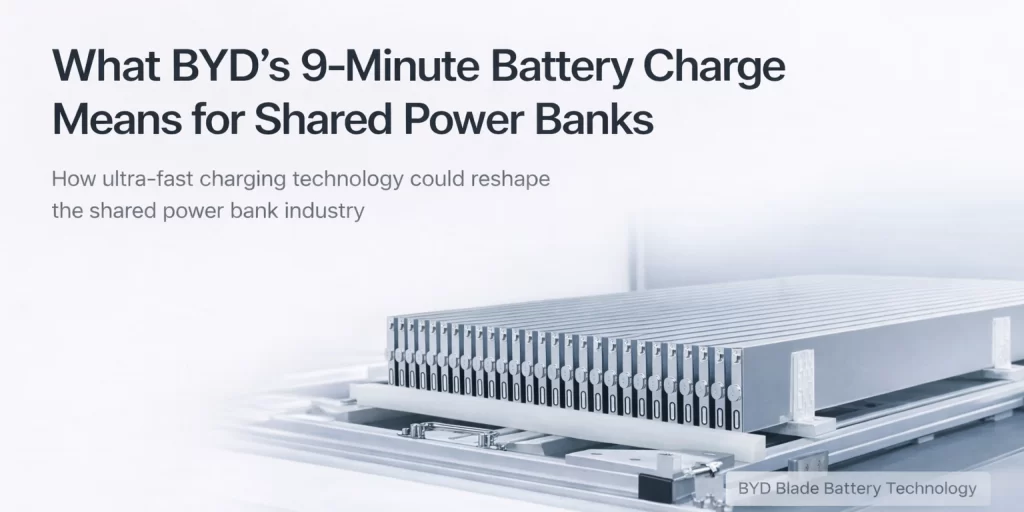
Yesterday (March 5), BYD unveiled its second-generation Blade Battery in Shenzhen, China. One data point immediately sent shockwaves through the entire new-energy industry: charging from 10% to 97% in just 9 minutes.
As someone working in the shared power bank industry, my first thought upon seeing this news wasn’t electric vehicles—it was the countless charging cabinets we maintain every day. What would happen to our operational efficiency if the time it takes for our cabinets to recharge power banks could approach this level?
Table of Contents
- Part 1. Let’s Understand What BYD Actually Achieved
- Part 2. The “Recharging Dilemma” for Shared Power Bank Operators
- Part 3. If Cabinet Recharging Moves Toward “Flash Charging”
- Part 4. The Technology vs. Reality
- Part 5. Rethinking the Shared Power Bank Business Model
- Part 6. Back to the Operator’s Perspective
Part 1. Let’s Understand What BYD Actually Achieved
Before discussing the potential impact on our industry, it’s important to understand the key technical breakthroughs.
The second-generation Blade Battery introduces three major improvements:
Charging Speed:
At room temperature, charging from 10% to 70% takes just 5 minutes, while 10% to 97% takes 9 minutes. The cell energy density exceeds 200 Wh/kg, and system-level energy density has improved by approximately 36% compared with the first generation.
Cold-Weather Performance:
After being frozen for 24 hours at -30°C (-22°F), charging from 20% to 97% still takes only 12 minutes—just three minutes slower than under normal temperatures.
Lifespan and Safety:
Cycle life has been significantly improved, with the guaranteed capacity retention rate increasing by 2.5% overall. After more than 500 fast-charging cycles, the battery reportedly passed a nail penetration test during active charging, with no visible smoke or flames.
At the launch event, BYD described the second-generation Blade Battery as effectively solving the long-standing challenges of slow charging and poor low-temperature charging performance.
Each of these improvements directly connects to the daily operational pain points faced by shared power bank operators.
Part 2. The “Recharging Dilemma” for Shared Power Bank Operators
Let’s start with a simple operational reality.
How fast do today’s shared power bank cabinets recharge the units inside?
Taking mainstream products as an example, a 8-slot cabinet typically takes 3–4 hours to fully recharge all returned power banks.
What does this actually mean in practice?
If you’re a restaurant owner, during the lunch peak from 11 AM to 2 PM, six out of eight power banks may be rented out. Between 2 PM and 5 PM, units are gradually returned, but the cabinet needs around three hours to fully recharge them. By the time they’re ready, the dinner rush has already begun—and the cabinet may only have two or three available units.
No inventory during peak hours means directly lost revenue.
If you’re a regional operator, the challenges become even more concrete:
High labor costs for battery swapping
Many operators rely on overnight patrol teams to swap batteries. One person covering dozens of locations means labor costs often account for more than 30% of operational expenses.
Low equipment utilization
The industry average rental frequency per slot is about 3.2 times per day, but peak-hour shortages mean the actual revenue ceiling is artificially limited.
Depreciation pressure
Standard lithium batteries typically last 500–800 charging cycles. With the high-frequency usage of shared power banks, units often require replacement after about one year.
According to industry data, China’s shared power bank user base has already exceeded 480 million, with annual orders surpassing 10 billion.
Globally, market research indicates that the shared power bank station market was valued at approximately $1.565 billion in 2024 and is projected to reach $3.893 billion by 2031, with a 13.9% CAGR. Another report forecasts the global portable battery sharing market to grow from $3.11 billion in 2025 to $6.37 billion by 2033.
These growth projections depend heavily on solving operational efficiency challenges—precisely where BYD’s latest battery technology offers inspiration.
Part 3. If Cabinet Recharging Moves Toward “Flash Charging”
Of course, EV batteries and power bank batteries are not the same. But the direction of technological diffusion is clear. If the shared power bank industry can eventually adopt similar concepts, operators’ cost structures and efficiency models could be fundamentally reshaped.
1. Higher Safety Standards Reduce Operational Risk
BYD’s nail penetration test has long been considered an industry benchmark. After 500 fast-charging cycles, the second-generation Blade Battery reportedly remains smoke- and flame-free even when subjected to a nail penetration test while charging.
For shared power bank operators, safety represents a major hidden cost.
In recent years, 81% of reported power bank incidents have involved uncertified or low-quality products.
China’s new national standards, scheduled to take effect in June 2026, significantly raise safety requirements. Batteries must now pass:
- 135°C high-temperature testing for 60 minutes
- 1.4× over-voltage testing
- nail penetration tests
If the structural safety design and thermal-runaway prevention concepts behind the Blade Battery could be applied to power banks, operators’ liability risks and safety-related maintenance costs could drop significantly.
2. Replenishment Efficiency Could Improve from Hours to Minutes
This would have the most direct impact on operational models.
Imagine a 8-slot cabinet, completely depleted, reaching 80% charge in just 15 minutes.
What would this enable?
Peak-hour top-ups become possible
During the lunch rush, an operator could visit a location, grab a coffee, and leave with the cabinet fully recharged for the afternoon demand.
Reduced patrol frequency
If cabinets recharge quickly, the overnight centralized battery-swapping model could shift to quick top-ups before peak hours, reducing labor costs.
Smaller, denser cabinet deployment
With faster replenishment, cabinets would no longer require large battery reserves, enabling more flexible and compact installations.
Meanwhile, BYD plans to build 20,000 flash-charging stations nationwide by the end of 2026, including 2,000 along highways. As of early March 2026, the company had already completed over 4,000 stations.
This infrastructure rollout is also shaping user expectations. Once EV drivers become accustomed to 9-minute charging, their tolerance for slow charging in other battery-powered services may decline.
3. Power Bank Lifespan Could Double, Cutting Depreciation in Half
The second-generation Blade Battery significantly improves cycle life.
For comparison, new national standards will require power bank cycle counts to increase from 300 to over 600 cycles.
If shared power banks could reach this level, a single unit could theoretically last more than two years (assuming one full charge per day).
For operators, this represents a very tangible cost reduction. Depreciation is currently one of the largest hidden costs in the shared power bank business.
If equipment lifespan doubles, the entire ROI model changes.
Major players are already positioning for this shift. Power battery manufacturers such as BYD are increasingly entering the consumer battery supply chain.
4. Cold-Weather Operations Could Finally Become Reliable
For operators in high-latitude regions, winter performance has long been a major operational challenge.
Outdoor locations often experience situations where the power bank appears charged but fails to charge a user’s phone. Users return the unit with remaining battery, but the next renter finds it unable to deliver power.
BYD’s low-temperature self-heating technology—where battery modules internally generate heat under cold conditions—could theoretically improve small battery performance as well.
The second-generation Blade Battery charges only three minutes slower at -30°C than at normal temperatures. If similar thermal-management concepts eventually reach smaller batteries, the value of outdoor locations in colder regions could change significantly.
Part 4. The Technology vs. Reality
Of course, EV battery technology cannot simply be transplanted directly into power banks.
Several practical challenges remain:
Size constraints
The Blade Battery uses a rigid blade-style structure, while power banks typically rely on polymer pouch batteries.
Cost considerations
Advanced battery technologies take time to scale down in cost, and early adoption could be expensive.
Battery management systems (BMS)
BYD’s BMS architecture is highly sophisticated; smaller devices would require simplified versions.
However, the real significance of technological breakthroughs often lies not in direct replication, but in expanding the boundaries of what’s possible.
Part 5. Rethinking the Shared Power Bank Business Model
Shared power banks are essentially a combination of local lifestyle services and smart hardware.
In recent years, the industry has seen growing discussion around pricing, billing transparency, and return convenience. Behind many of these concerns lies a deeper issue: operational efficiency bottlenecks.
When replenishment costs are high and equipment depreciation is significant, operators often rely on higher per-use pricing to maintain profitability.
But if battery technology improves replenishment efficiency and equipment lifespan, the industry could shift from a model of “high price, low frequency” to “reasonable price, high frequency.”
Part 6. Back to the Operator’s Perspective
As an operator, you probably don’t care about lithium-ion high-rate charging channels or all-climate thermal management systems.
You care about much simpler questions:
- How long does it take for my cabinet to recharge?
- Can I capture more rentals during peak hours?
- How long will this batch of devices last before replacement?
- Will my outdoor locations still perform in winter?
Ultimately, the answers to all of these questions point to the same foundation:
battery technology.
The battery BYD unveiled yesterday may be designed for vehicles, but it sets a new benchmark for the entire lithium battery industry.
Shared power banks, as a niche application of lithium batteries, will eventually benefit from this broader technological wave.
In 2025, China’s shared power bank industry entered the era of precision operations. The average device is rented 3.2 times per day, and mature locations generate 300–800 RMB in monthly revenue.
Further growth will increasingly depend on improvements in the underlying technology.
Perhaps one day soon, the status on your operator dashboard will read:
“Flash Charging Enabled — Full Recharge in 15 Minutes.”
And when that day arrives, it may all trace back to a battery that reached 97% in just 9 minutes, unveiled on March 5, 2026.
This article is based on information from BYD’s second-generation Blade Battery launch on March 5, 2026. The discussion about technology transfer reflects industry analysis and speculation; actual product developments may vary.